Recruiting site managers - Why construction loses its site leadership before recruitment even starts
- news
Every construction company has vacancies that stay open for months without anyone being able to explain why. Recruiting site managers is the textbook example. The salary is competitive, the projects are lined up, and still nothing moves. The same goes for project managers and work planners: the people who keep a site running, and who you cannot simply pull in from another trade.
The reflex is to advertise harder. More budget, a new job ad, another agency on the case. More often that is mopping the floor with the tap running: the real problem sits after the hire, not before it. So we never start with a campaign. We start with the question: which number has to move, and where is it leaking today?
What problem are you actually solving when recruiting site managers?
Before you spend a euro on media, you want five numbers on the table. How many site managers and project managers left last year. How long such a vacancy stays open. How many serious candidates you need for one placement. How many people drop out between the first conversation and the signature. And how many of last year’s hires are still there after twelve months.
That baseline decides what you should do. If you lose two in ten site managers a year, no campaign is big enough to compensate. If your process takes six weeks while a competitor makes an offer within ten days, visibility is not your problem, throughput is. If candidates walk away because the job turns out to be different from the picture, the leak is in the promise.
The market does not help. The Dutch public employment service UWV reported that in the first quarter of 2026, 87 out of 93 occupational groups were tight or very tight, with technical occupations at the top. That is not a reason to shout louder, but to choose more precisely. And share those numbers internally, because you win support from directors and project teams with figures, not with a moodboard.
Why do site managers and project managers actually leave?
In its Construction Workforce Outlook 2026 to 2030, the UK’s CITB describes a pattern that is just as recognisable across Europe: too few people are entering the industry and too many experienced people are leaving. For site based leadership roles, that second half hurts most. You are not losing someone who could not do the job, you are losing someone who did it well for years.
Ask leavers why, and it is rarely about money alone. It is about responsibility without authority, schedules fixed somewhere else, Saturdays that are silently part of the deal, a phone that rings on Sunday evening. A job comes home with you, and in these roles literally: the family notices when a project overruns.
That is why exit interviews and conversations with people who joined a year ago teach you more than any trend report.
What can we learn from construction abroad?
Australia has put hard research behind this. Led by Helen Lingard and Michelle Turner of RMIT University, construction projects were run under a culture standard capping the working week at fifty hours with two consecutive days off. Of the salaried staff, 93 percent wanted to keep the five day week, and among waged workers it was 71 percent.
The surrounding results are even more interesting. Turnover on those projects was 4,4 percentage points lower than at the same head contractors elsewhere. Women made up 32 percent of the pilot project staff against 24 percent in the wider workforce. And the cost benefit analysis by Frontier Economics found no evidence that the projects took longer or cost more.
The lesson is uncomfortable and useful at once. The strongest recruitment message for site managers is often not a message at all, but a change in the work itself. Make it and you have something a competitor cannot copy. Skip it and every campaign is a cheque your people on site have to cash.
What does an employee value proposition look like that survives on site?
We build a solid employee value proposition on three pillars. Image: what the outside world says about you, how you are found, what picture tradespeople have of the work you do. Internal: what your own site managers say, what is actually true about the culture, how setbacks are handled. Market: what the sector offers, and who you are really competing with for the same people.
The distinctiveness lives in the overlap. What is true inside, what this audience genuinely looks for, and what the market does not offer. Values on their own will not get you there. Driven, ambitious, makers: every contractor claims it, which is exactly why it says nothing. You do not claim a culture, you let people feel it. Have a site manager explain how he fixed a mistake, rather than a director explaining that there is room to make them.
Your recruitment strategy also has to match how the organisation actually works. Recruit on autonomy while every decision is made centrally, and you attract exactly the people who will be gone within a year.
Why is recruiting site managers also a filtering problem?
You want to attract talent, but the right talent. For these roles an honest picture is worth more than a flattering one. If most of your work is large inner city projects with heavy public pressure, say so. If the average commute is fifty kilometres, say that too. If your site managers arrange a lot themselves, name the downside of that freedom.
Every candidate who drops out because of it is a win. It saves interviews, a wrong placement, and a departure within the first year, which in these roles is the most expensive thing that can happen to you. A good employer brand works as a magnet and as a filter at the same time.
How short is the route from interest to conversation?
Not every question needs a campaign. A site manager considering a move looks around for months before applying, often in the evening, on his phone. If your careers site then asks for three clicks and a cover letter, you lose him to the company that asks for a phone number and calls back within a day.
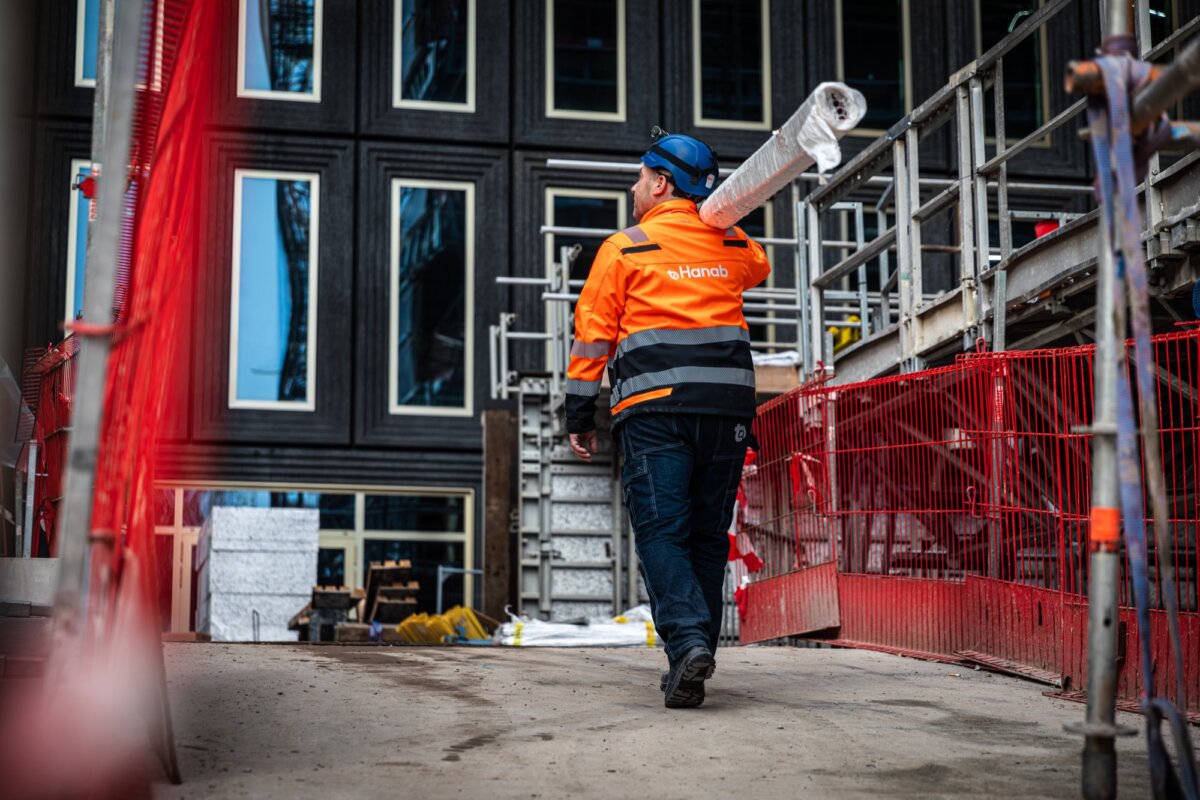
In practice the biggest gains often sit in things that never appear on a campaign brief: a better employer brand and careers platform, a shorter procedure, a way to make contact without committing, and content that stays visible all year instead of peaking for four weeks. For Hanab, part of VolkerWessels, we work from a continuous content line made on the projects themselves, rather than separate vacancy campaigns per opening.
What can AI do here, and what can it not?
Candidates are researching you with a chatbot. In a study by Gdoc.io among 500 US job seekers, 36 percent said they use AI while looking for work, 80 percent of them using ChatGPT, and 54 percent never tell an employer about it. So a conversation about your company is happening without you in the room, and what comes out of it depends on what can be found about you: job descriptions, employee stories, reviews, news.
AI is also excellent at scale. Testing variants, adapting ads by region and role, subtitles, fast edits. What AI cannot do is supply substance you do not have. Why synthesise a site manager you could simply film? The real stories of your own people are exactly the part no model can produce, and the part candidates spot instantly. We wrote more about that in our piece on AI in employer branding.
How does MonFri approach recruiting site managers?
We start with the client’s question, not with a format. First the baseline and the funnel: where does it go wrong, in inflow, in throughput or in retention. Then research among your own site managers and project managers, a market picture of the employers you genuinely compete with, and from there an employee value proposition that holds up against the reality on site.
Only then comes execution: content made on location, a careers environment that works on a phone, media that keeps you visible all year, and measurement that shows what it delivered. That is recruitment that also serves retention, because the candidate journey does not stop at the signature.
Want to know where your funnel is leaking? Have a look at our services, call 020 23 38 587 or email hi@mon-fri.com.


