Recruiting construction workers - Why your vacancy is not the problem, your visibility is
- news
Dutch employer research published by UWV in April 2026 found that 45 percent of all vacancies were hard to fill, and that in construction this rises to 71 percent. Almost three quarters. And yet recruiting construction workers still starts in the same place at most firms: put the job ad online, bring in an agency, and hope.
That works less and less well, and it is not where the problem sits anyway. When there is barely an actively searching carpenter or site manager left, you do not win by shouting louder in the place where everyone is already shouting. You win because people who are not looking at all already know you. That is not a vacancy. That is an employer brand.
Why is recruiting construction workers so stubbornly hard?
Labour shortage is the easy answer, and it is true. But it does not explain why one construction firm keeps its crews full and the one down the road does not, in the same region, with comparable work and comparable pay. That difference rarely sits in supply. It sits in visibility and credibility.
Most tradespeople in construction are not looking. They are working, reasonably content, and they move when something makes them think: I would like to stand there. That moment happens at the coffee machine or on a brother-in-law’s phone, not on a job board. If you are only visible when you have a vacancy, you reach the small group that happens to be searching right now. The group everyone is fighting over.
On top of that, construction carries an image that lags behind reality: heavy, dirty, insecure. For a lot of firms that stopped being true years ago, but nobody sees it. If you do not show what the work actually looks like, the sector’s average image decides what people think of you.
What are tradespeople actually looking for in an employer?
Here is the first big mistake we run into: companies decide for themselves what their audience wants to hear. Out comes “an informal atmosphere” and “plenty of room to grow”. Fine words, but they say nothing, and every competitor says them too.
The Randstad Employer Brand Research, which surveys around 160,000 respondents across 34 markets every year, keeps producing the same picture: salary and work-life balance top the list when people choose an employer, and those are also where employers perform worst according to the same respondents. That gap is your opening. Not by paying more, but by daring to be concrete.
ADP Research analysed five years of payroll data for its Today at Work report. In it, only 18 percent of construction workers strongly agreed that their employer invests in their skills, and 25 percent that they have the skills to advance. Translate that into your own story: if you genuinely train people, and you can back it up with names and programmes, you have something to say that almost nobody else is saying.
So we never start with the organisation, we start with the talent. Who are you looking for, what moves that person, and who are they comparing you with. You answer those questions with conversations and data, not around a meeting table. We wrote about that earlier in start with the talent, not with yourself.
Why is the job board not your problem, but your employer brand?
A vacancy is a moment. An employer brand is a position. You notice the difference on the day you need three site managers at once: the firm that is visible year-round has a list of people who have already been in touch, the firm that only advertises in an emergency starts from zero, at a higher rate.
That does not mean everything has to be a campaign. Often the gain sits elsewhere: a careers site that shows what a working day looks like, an application process that goes from eight days to two, content that stays up all year instead of three weeks of ad budget. On every brief we first check whether the question is a campaign question at all. More on that foundation in our piece on the recruitment website.
What can you learn from the German approach?
Germany has the same problem, only bigger, and handles it differently. The Zentralverband des Deutschen Handwerks runs a national skilled crafts campaign together with the 53 chambers of crafts. According to CEDEFOP, around 350,000 apprentices worked in the German crafts sector in 2024, while more than 20,000 apprenticeship places stayed empty.
What is interesting is not the scale but the method. They do not just advertise, they let people experience. A Handwerksmobil tours schools where children actually build something, there are school competitions, and programmes that teach companies to recruit on social media themselves. The logic: you do not change the image of a trade with a message about that trade, you change it by putting the trade in people’s hands.
That principle travels well, certainly for career switchers. Someone of 34 moving from logistics into installation work is not convinced by a job ad but by a day on site. So make the first step in your funnel an experience, not an application.
How do you make recruiting construction workers filter people out too?
This is where we most often push back on clients. A good employer story is both a magnet and a filter. You do not want as many applicants as possible, you want the right ones. Which means being honest about what does not work for everyone: the early starts, the travel to sites, standing outside in winter.
That feels counterintuitive, but it is well supported. The meta-analyses on realistic job previews, including Phillips in 1998 and Earnest, Allen and Landis in 2011, find that an honest preview lowers turnover. The mechanism the most recent analysis proposes is telling: it works mainly because it signals that the organisation is honest.
Do the maths. What does a site manager who leaves after four months cost you? Recruitment, onboarding, disruption on the project, and the gap you fill again. Ten applicants of whom two fit is cheaper than forty of whom two stay. And a job comes home with people, so the promise you make has to be delivered by real colleagues on site.
Where does AI help, and where does it not?
On the candidate side: research by Gdoc.io among 500 US job seekers in April 2026 found that 36 percent use AI while searching, nearly 80 percent of them ChatGPT. So there is increasingly a model sitting between you and the candidate, summarising what kind of employer you are. What can be found about you, in your own words, partly decides what that model says.
On the production side, AI is excellent for scale. Ad variants, translations, tests per region and audience, fast adjustment to what works. We get a lot of speed out of that, and it frees up budget you spend elsewhere.
But the substance stays human work. Why generate a technician when you can simply film one? The story of someone who has spent twenty years in road construction, in their own words and their own accent, is exactly what no model can produce. In construction especially, a synthetic face is spotted instantly.
Which number actually has to move?
The question we always ask in the first session: what is the real problem here? Sometimes it is intake, just as often it is something else. Too few suitable applicants rather than too few applicants. A three-week process that loses candidates to whoever calls faster. Or turnover in the first year.
So decide upfront which number has to move, and take a baseline. Applicants per vacancy, share suitable, time from first contact to contract, attrition within twelve months, and recruitment spend against saved agency costs. That mostly gives you internal backing, because a board that sees a number move extends the budget without debate.
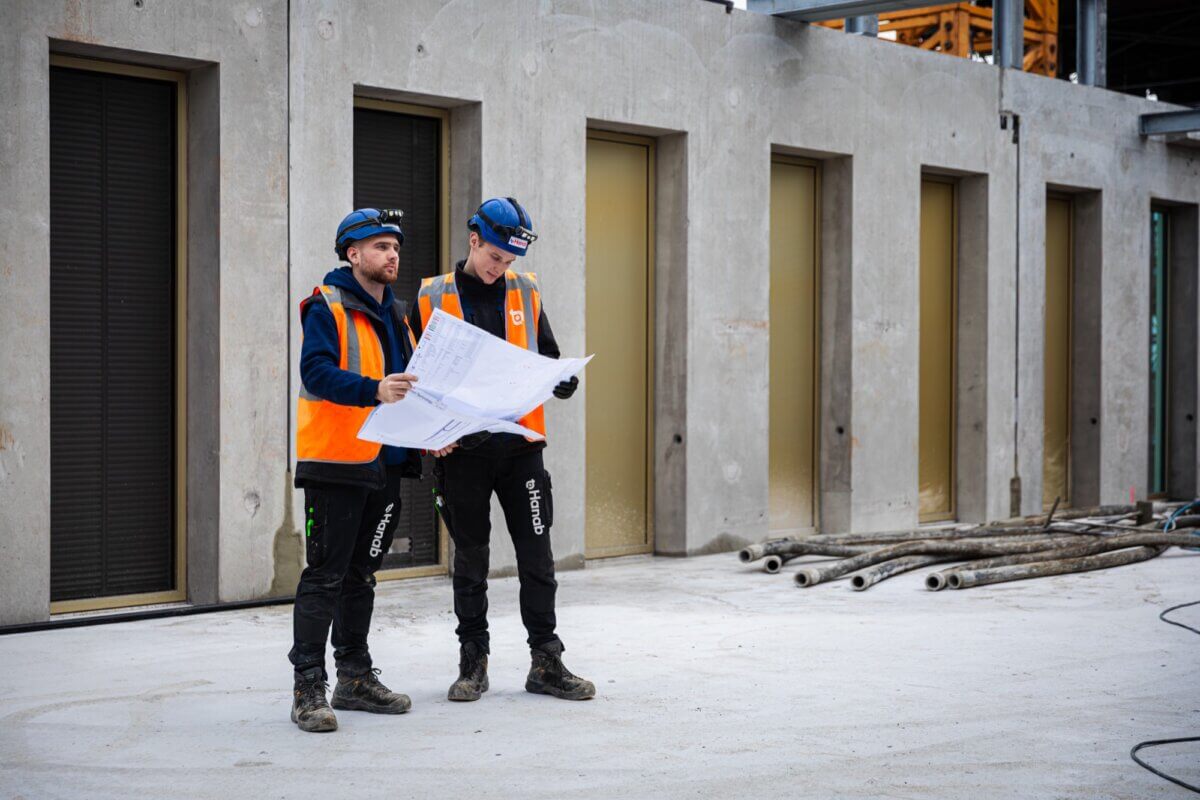
For Hanab, part of VolkerWessels, we work in exactly that order: first get clear who they need and where the funnel breaks, then decide which tools solve it. That often saves a lot of wasted budget. More on that way of working in recruiting technicians in a tight labour market.
How does MonFri approach recruiting construction workers?
We are an employer branding agency that starts with the talent and ends with a number. In practice: research among the people you want and those you already have, an honest employer story that attracts and filters, and tools that fit. Sometimes a campaign, often a better careers platform, content shot on site, a shorter application process.
Want to know where yours breaks down? We are happy to look at your funnel before anything gets made. See our services, call 020 23 38 587 or email hi@mon-fri.com.


